Tampa Roofing Website Redesign
Planning example: a Tampa roofing website redesign plan that keeps useful URLs, clarifies services and tests inquiry paths before launch.

- Market
- Roofing
- Service
- Website Systems
- Year
- 2026
- Focus
- Website Strategy
A roofing website redesign should make it easier to choose a service and contact the right team. This illustrative Tampa scenario explores how RenForge Studio would plan that change while accounting for the pages and links people already use. It is a proposed approach, not a completed client project or a report of measured results.
The brief: improve the website without losing useful routes

Imagine a Tampa roofing company with separate repair, replacement and tile-roofing pages. Its site looks dated, and a new visual design is ready. The owner wants a cleaner mobile experience. The risk is that the rebuild treats every old page as disposable, including pages customers have bookmarked or found through search.
The first deliverable would be a page inventory, not a new homepage mockup. For each public URL, the team would record its purpose, current content, incoming internal links and inquiry action. With permission to use the business accounts, Search Console and analytics would help identify pages receiving impressions, visits or meaningful inquiries. Those signals would inform the plan; they would not replace a review of the content.
The working brief would separate three decisions: what stays at its existing address, what needs a better destination, and what no longer helps customers. A useful repair page would not disappear simply because the new navigation is shorter. The proposed site would keep clear routes for repair and replacement, with factual material information and service coverage confirmed by the owner.
The proposed system: map pages and make the next step clear

For this scenario, the repair page would explain the kinds of issues the company can assess, what information is useful before a visit, and how to request an inspection. The replacement page would explain the consultation process and what affects a written proposal. Neither page would promise an insurance outcome, a fixed project price or emergency availability without business approval.
Existing URLs would stay where practical. Where an address genuinely changes, a migration sheet would pair the old page with the closest relevant replacement. Google’s site-move guidance supports planning URL mappings, redirects and monitoring. A blanket redirect of every retired page to the homepage would not be the proposed solution.
The design review would follow an ordinary customer task on a phone: find a service, read enough to decide, then call or send an inquiry. Buttons would describe that task, such as “Request a roof inspection.” The form would collect contact details, property city and a short description, with optional photos only if the team can receive and handle them reliably. A visible confirmation would explain the next step without presenting the request as a booked appointment.
Launch checks and the evidence needed afterward

Before launch, the team would test representative old and new URLs, navigation links, image loading, form labels, error messages and the destination of inquiry notifications. It would confirm the intended canonical addresses and check that staging restrictions are absent from the public site. The sitemap would contain the final public URLs rather than preview or retired addresses.
A launch record would distinguish a button click from a delivered form and a qualified roofing inquiry. If analytics is in scope, test traffic would be identified so it does not look like new business. The owner would confirm who reviews submissions and who can correct a routing problem. A working form with no responsible recipient would fail the handoff.
After launch, Search Console would be reviewed for crawl or indexing problems and for changes in page-level search performance over a suitable period. Inquiry records would add context that rankings alone cannot provide. This study makes no traffic or revenue claim. Its intended outcome is a controlled redesign with clear page ownership, useful service content and a tested route from a roofing question to the team that can answer it.
RenForge Studio builds website systems and provides branding and digital marketing support for roofing, HVAC, contractors, real estate and service businesses. Explore RenForge services or discuss your website and priorities. For practical next steps, read our local SEO checklist for a website redesign.
Acceptance checks for the proposed redesign
This planning example would be ready for a launch decision only after the following checks. They are proposed acceptance criteria, not completed tests or measured client results.
- Useful URLs retained: the page inventory identifies each existing service page and its destination. A changed address has a relevant redirect rather than a blanket homepage redirect.
- Customer tasks verified: a phone visitor can distinguish repair from replacement, read the service boundaries and find the appropriate contact route.
- Inquiry handoff verified: an authorized test reaches the responsible inbox. Errors are readable and the confirmation does not claim an appointment is booked.
- Search output reviewed: final pages have the intended canonical addresses, useful titles, accurate descriptions and no staging restrictions.
- Evidence recorded: the team retains the URL map, approvals, test notes and launch date. Search and inquiry comparisons wait for a suitable complete reporting period.
What would count as evidence of a successful redesign?
A controlled launch and working inquiry route show that the proposed system operates as intended. Better rankings, CTR or qualified inquiries would require dated before-and-after records with comparable filters. This study does not claim those outcomes.
Use the Tampa roofing SEO keyword map to decide which pages serve different searches. The roofing web design service-path study and refresh-versus-rebuild cost study explore related planning decisions.
Sources and image credits
Further reading that informed this proposed approach:
- Google Search Central: site moves with URL changes
- Search Engine Journal: essential steps for a website migration
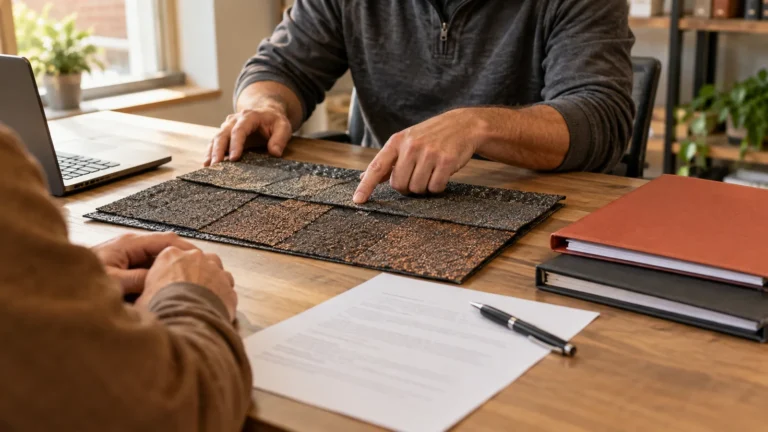
Featured image: original concept illustration created for RenForge Studio. It does not depict a client project, property listing or completed installation. Section photographs are credited above and used under the Unsplash License. They illustrate the topic and are not evidence of RenForge client work or verified local properties.